

How to Declutter When Your Spouse Doesn’t Want To

You want to eat at the dining table without moving a stack of things first. Your spouse wants those things left where they can find them. By the time you suggest a donation box, you’re having the same argument again.
To declutter when your spouse doesn’t want to, start with belongings you can decide about yourself. For shared spaces, agree on a specific improvement, such as having room to eat dinner or reach the closet. Ask before removing their things, and work out where the items they want to keep will go.
You may never want the same amount of stuff. You can still work toward a home where both of you have room to live.
Start With the Daily Frustration You Want to Fix
“We need to declutter this house” asks someone to agree to a large project before they know what it involves. Choose the part that is making an ordinary day harder.
Perhaps you have to move hobby supplies before you can cook. Maybe the chair where you put on your shoes is always covered. Explain that specific difficulty and what you need to be able to do.
You might say:
“I’m frustrated that I have to clear the table every time we eat. Can we find a place for the paperwork so we can sit down without moving it first?”
The Gottman Institute recommends describing a specific situation and expressing what you need without criticizing your partner’s character. Applied here, that means talking about the table and the daily work it creates, rather than calling your spouse messy or careless.
Ask what they need from the same space. The paperwork may be there because a bill gets forgotten when it goes into a drawer. That gives you something useful to solve together: a place where the bill stays visible and dinner still fits.
Have this conversation when neither of you is already sorting a pile in frustration. If it turns into an argument, pause and choose a time to return to the specific problem.
Sort Your Own Things Before Making Decisions About Theirs
Start with a drawer of your clothes, your toiletries, or supplies from a hobby you no longer enjoy. Choose something small enough to finish and put away in the time and energy you have.
This gives you useful progress even if your spouse never joins in. Avoid turning it into a demonstration of how much better you are at letting go, or leaving your donation bag beside their belongings as a hint.
When ownership or use is less clear, stop and check:
- Your personal belongings: You can usually decide about these yourself, while checking whether someone else relies on an item you plan to remove.
- Shared household items: Make the decision together. The serving dish you never use may be the one your spouse takes to every family gathering.
- Your spouse’s belongings: Ask before donating, selling, discarding, or packing them away. Something that looks abandoned to you may still matter to them.
An agreement to clear the counter is not necessarily permission to discard everything on it. Before sorting, be clear about whether you are putting things away, considering donations, or both.
Find Out What Makes a Particular Item Hard to Release
You do not need an explanation for every possession. But when one box or category keeps stopping the conversation, ask what your spouse is worried about losing.
“What would make this easier to decide?” leaves more room for an honest answer than “Why do you still have this?” Listen before offering a solution.
When They Are Worried About Needing It Later
Take the concern seriously, especially if replacing something would strain the budget. A tool used twice a year can still earn its space.
For an item they are willing to discuss, ask what job it would do and whether you already own something that does that job. If it stays, choose a location where it can actually be found. Keeping three spares is less useful if nobody knows where any of them are.
When the Item Holds a Memory
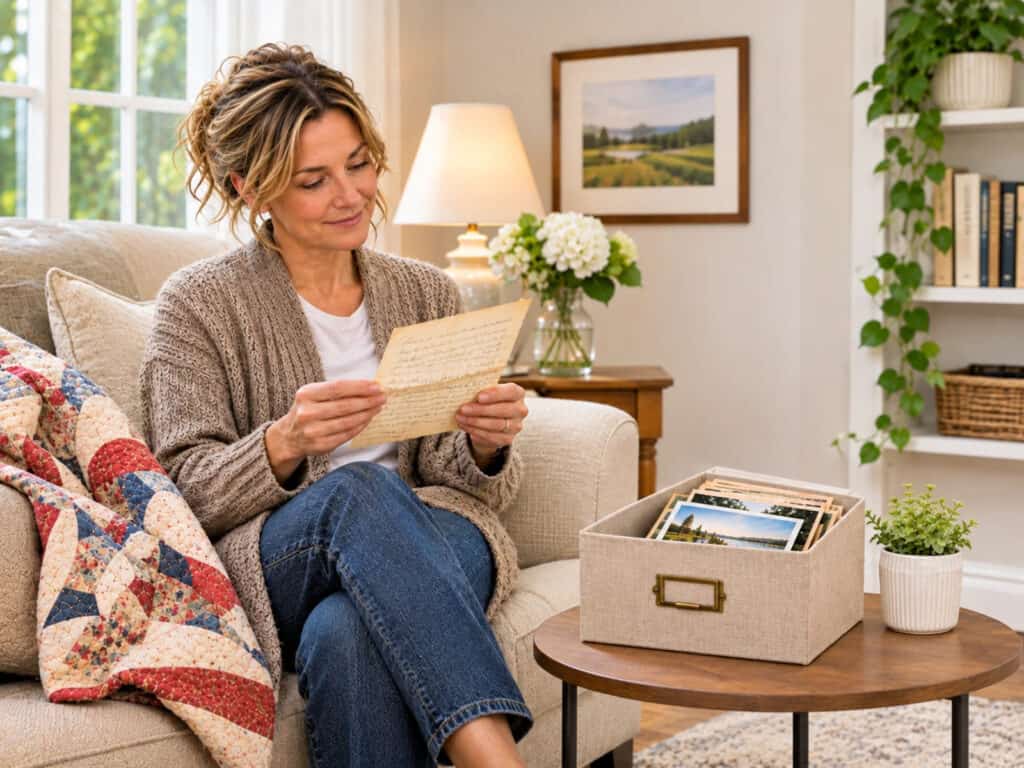
Let your spouse decide what the object means to them. A photo may be enough for one person; another may want the handwritten letter or the actual quilt.
You can ask whether they would like help displaying a favorite piece or gathering keepsakes into an existing box. If they want to consider letting some things go, my guide to decluttering sentimental items offers ways to work through those decisions without rushing them.
Leave the hardest keepsakes for a time when they want to consider them. A discussion about clearing the breakfast table does not need to become a decision about a parent’s belongings.
When They Do Not Have the Energy to Sort
Ask whether a smaller task would help. They might be willing to look through five magazines while seated, even though emptying an entire bookcase sounds exhausting.
Offer a specific kind of help if they want it: bringing a small group of items to the table, carrying things to their chosen places, or handling an agreed donation drop-off. Let them make the decisions about their belongings. If today is a no, finish your own small project and put the room back in order.
Make One Shared Space Easier to Use
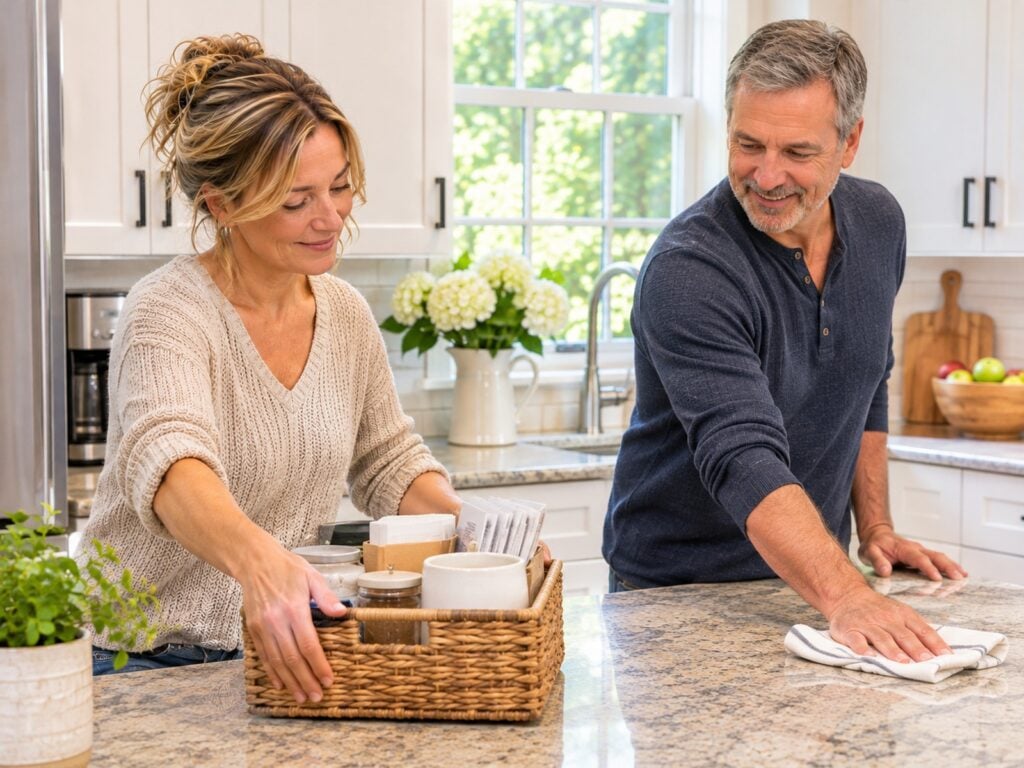
Choose an area that affects you both, then agree on what needs to fit there. Start with function: a place to prepare food, a usable seat, or room to open a closet door.
A dining-table agreement might look like this:
- The table can be used for paperwork during the day, and it is cleared before dinner.
- Current papers go in a tray on a nearby shelf you have both agreed to use.
- Each person moves their own papers. Bills and documents are handled separately from any donation sorting.
- You try the arrangement for a week, then discuss what was inconvenient.
Use a tray or box you already own. If your spouse needs to see the papers to remember them, an open tray may work better than a lidded box. If bending or lifting is difficult, choose an easy-to-reach spot and keep the load light.
In a small home, the same surface may serve several purposes. Agreeing when it needs to be available can be more realistic than expecting it to stay empty all day. A puzzle board that can be moved before dinner, for example, lets a project continue without taking over every meal.
The details should fit both people. A system that requires you to carry everyone’s things around each evening needs another conversation about the work involved.
Agree on Space for the Things That Are Staying
Keeping belongings still requires somewhere to put them. Talk about that space together rather than assigning your spouse a tiny corner and expecting everything to fit.
Suppose hobby supplies are spreading across a shared room. Look at what is actively being used, where it needs to be accessible, and what storage is already available. Your spouse might choose a cabinet for supplies and a tray for the current project. You might agree to keep the nearby chair available for sitting.
If the cabinet fills, revisit the choices. They may decide to reduce duplicates, finish a project, or discuss using more space. Expanding into your drawer or the shared walkway should not happen by default.
Apply the same expectations to your belongings. A fair arrangement considers use, access, and available room; it does not have to give each person an identical number of shelves.
For a “maybe” box, agree on its purpose and where it will live. A date can remind you to look through it together. It is not automatic permission to donate the contents if your spouse has forgotten about it.

Make the Follow Through Part of the Agreement
Deciding to let something go is only part of the task. Agree on the next step while you are both looking at it.
If your spouse wants to sell an item, discuss who will photograph it, write the listing, answer messages, and arrange collection. If neither of you wants to do that work, consider another option together. Avoid quietly inheriting the selling job because you were the person who wanted less clutter.
Keep agreed donations separate from undecided belongings. Before a shared donation bag leaves, confirm that both of you are comfortable with its contents.
When clutter returns to the same spot, ask what made the arrangement difficult to use. Was the tray too small? Was the storage inconvenient? Did “I’ll put it away later” leave you clearing the table every night?
Change the part that is causing the problem. If the arrangement is practical but the agreed task repeatedly falls to you, say that directly: “I’m still moving the papers before dinner. What can we agree on that doesn’t leave that job with me?”
If Your Spouse Still Does Not Want to Declutter
You can continue making decisions about your own things and ask for shared areas to remain usable. You do not have to adopt your spouse’s preferred level of clutter, and they do not have to become a minimalist.
Try separating the request to remove belongings from the request to use the room:
“I understand that you want to keep these. I also need to be able to use this chair. Can we decide together where they can go?”
If every possible location is full, acknowledge that limit. Moving the pile into another crowded room will not create more space. You may need to revisit which activities and belongings the available room can accommodate.
There may not be an agreement that day. Continue the work you can do, without treating your progress as a promise that your spouse will eventually change. If conversations repeatedly go nowhere, you could suggest a neutral organizer you both agree to involve for practical storage decisions.
When the Problem Needs More Support
Reluctance to declutter alone is not enough to identify hoarding disorder. If belongings prevent rooms from being used, obstruct exits, or cause intense distress when discarding is discussed, seek qualified support. The International OCD Foundation’s guidance for families explains why clearing someone’s possessions without their consent can make the situation worse and offers ways to seek help.
Choose a Starting Point You Can Finish Today
Choose one small group of your own belongings: the scarves you never reach for, the mugs only you use, or the supplies from a project you have decided to stop. Put away what you are keeping and finish dealing with what you are ready to release.
If having a daily task would help you keep going, join my free 14-Day Declutter Challenge. Apply the tasks to your own belongings, and agree with your spouse before sorting anything shared. You can begin with what is yours today.